
MSE MA Economics Entrance: The Ultimate 2026 Preparation Guide
The MSE MA Economics Entrance is a key step for your career. This guide helps you master the syllabus. It also helps you clear high cutoffs. To succeed, you must understand the exam pattern. Overall, this roadmap is for students aiming for an MA in Economics at the Madras School of Economics.
Many students fail because they treat this like a college test. However, this exam needs a different approach. You should treat it like a strategy game. So, this guide by PMG Classes will help you. It also builds your confidence for exam day. We provide mentorship to help you perform better.
1. Decoding the MSE MA Economics Entrance Pattern
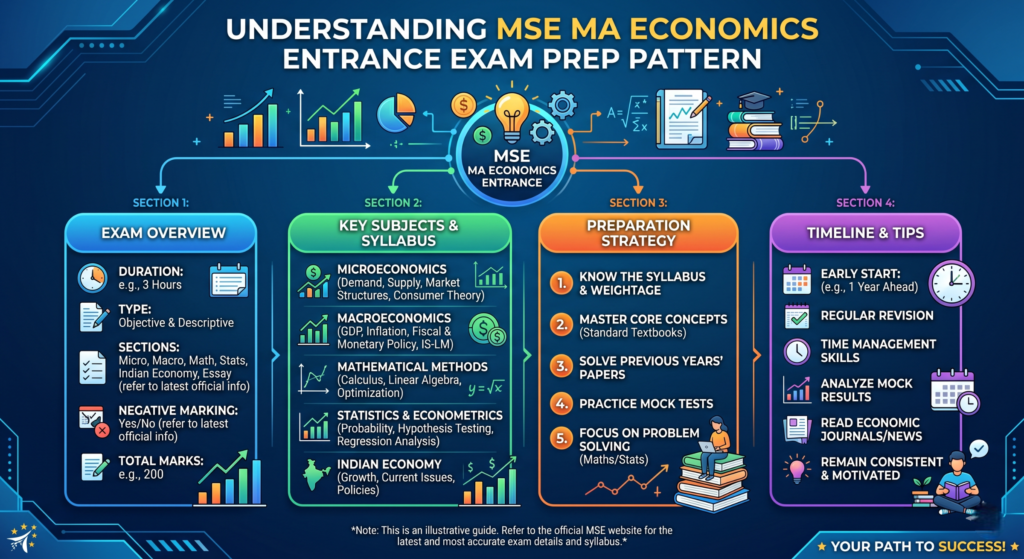
First, understand that this exam tests your speed. It has 100 MCQs. You get 120 minutes to solve them. Also, there is no negative marking. Because of this, cutoffs stay very high. So, you must avoid “lazy guesses.”
The exam has two parts. Section A covers Math, Stats, and English. Section B focuses on Economics. Many students ignore Section A. As a result, they lose easy marks. So, you must balance both sections. A good score in Section A often decides your selection.
2. MSE MA Economics Entrance Syllabus: Detailed Subject-Wise Guide
You need to master the core subjects. Here is how you should study the syllabus:
Mathematical Methods for Economics
Mathematics is the gatekeeper. So, do not stick to basic math. Instead, focus on Calculus and Linear Algebra. You should also practice Optimization and Integration. These topics appear every year. So, practice at least 20 questions daily to stay sharp.
Statistics and Probability
This is the core of the exam. First, learn the logic of Normal, Binomial, and Poisson distributions. Then, practice Sampling Theory and Hypothesis Testing. If your Stats are strong, you will have an edge. Many questions test your logic in probability.
Economic Theory and Indian Economy
Go beyond basic demand and supply. For Microeconomics, study the Slutsky Equation and Game Theory. For Macroeconomics, focus on the IS-LM model and the Solow Growth Model. Also, stay updated on the Indian Economy. Read about RBI policies and the latest Union Budget. These areas are scoring if you know the facts.
Which Campus Should You Aim For? Chennai vs. Delhi
The exam is the same. However, your campus choice depends on your goals. Some students prefer research. Others prefer corporate exposure. So, choose based on your plan. Here is a quick comparison:
MSE Chennai vs. MSE Delhi: Quick Comparison
| Feature | MSE Chennai (Main Campus) | MSE Delhi (Off-Campus) |
| Legacy | Oldest & Most Established | Newer Extension Centre |
| Primary Focus | Deep Quantitative & Financial Economics | Data Analytics & Policy Research |
| Alumni Network | Extremely Strong & Global | Growing Network |
| Location Advantage | Financial Hub of South India | Political & Corporate Hub (NCR) |
| Placement Cell | Dedicated & Highly Experienced | Shared Resources with Main Campus |
| Top Recruiters | Banks, Financial Services, Research Firms | Consulting, Think-tanks, Policy Labs |
| Campus Vibe | Traditional Academic Environment | Modern & Corporate Oriented |
| Cost of Living | Relatively Affordable | Higher (Delhi NCR rates) |
| Weather | Tropical (Hot & Humid) | Extreme (Hot Summers/Cold Winters) |
3. The PMG Study Philosophy for MSE MA Economics Entrance
Do not study for 14 hours daily. It leads to burnout. Instead, your brain needs rest. So, follow a structured routine.
- Quantitative Morning: Solve Math and Stats problems. Your mind is fresh in the morning.
- Conceptual Afternoon: Read Economics books like Varian.
- Revision Evening: Revise your notes daily. If you cannot explain a topic simply, you have not understood it.
4. . Common Mistakes in MSE MA Economics Entrance Preparation
Through our coaching, we found five common mistakes:
- Math Phobia: Do not skip Math. It is very scoring.
- Over-thinking: Look for quick tricks. Do not spend too long on one question.
- Ignoring English: These are easy marks. Practice comprehension.
- Resource Overload: Do not use too many books. Stick to one good source.
- No Mock Tests: Start mock tests early. Do not wait.
5. Final 30-Day Strategy
The last month is very important. It is also a mental game.
First, solve past papers from the last 10 years. Patterns often repeat.
Second, take full-length mock tests. This builds stamina.
Lastly, trust your hard work. Focus on short notes and stay calm.
Why Choose PMG Classes for Your Prep?
Preparation can feel lonely. However, the right guidance makes it easier. At PMG Classes, we offer expert mentorship. We also provide tests and clear notes. Our focus is on your strengths. We help you improve weak areas.
Let’s Connect & Start Your Preparation
📞 Call/WhatsApp: +91 9899312641
📧 Email: manojgargeco@gmail.com
📍 Expert Mentorship by Manoj Garg (PMG Classes)
Conclusion
Cracking the exam does not need magic. It needs discipline and clarity. So, start your journey with a positive mindset. Clearing the Madras School of Economics cutoff is possible. Trust the process and practice daily.
- A Strategic Roadmap: Know what to study and what to skip
- Deep Conceptual Clarity: Understand the logic behind theories
- Relentless Practice: Solve problems within time limits
With the right mindset, success is within your reach.
Expert Mentorship by PMG Classes
We recommend guided preparation. A structured test series helps a lot. At PMG Classes, we make your preparation organized and effective.
Final Words of Wisdom
- Stay consistent. Small daily wins lead to big results.
- Trust your prep. Your hard work will show.
- Stay confident. A calm mind wins half the battle.